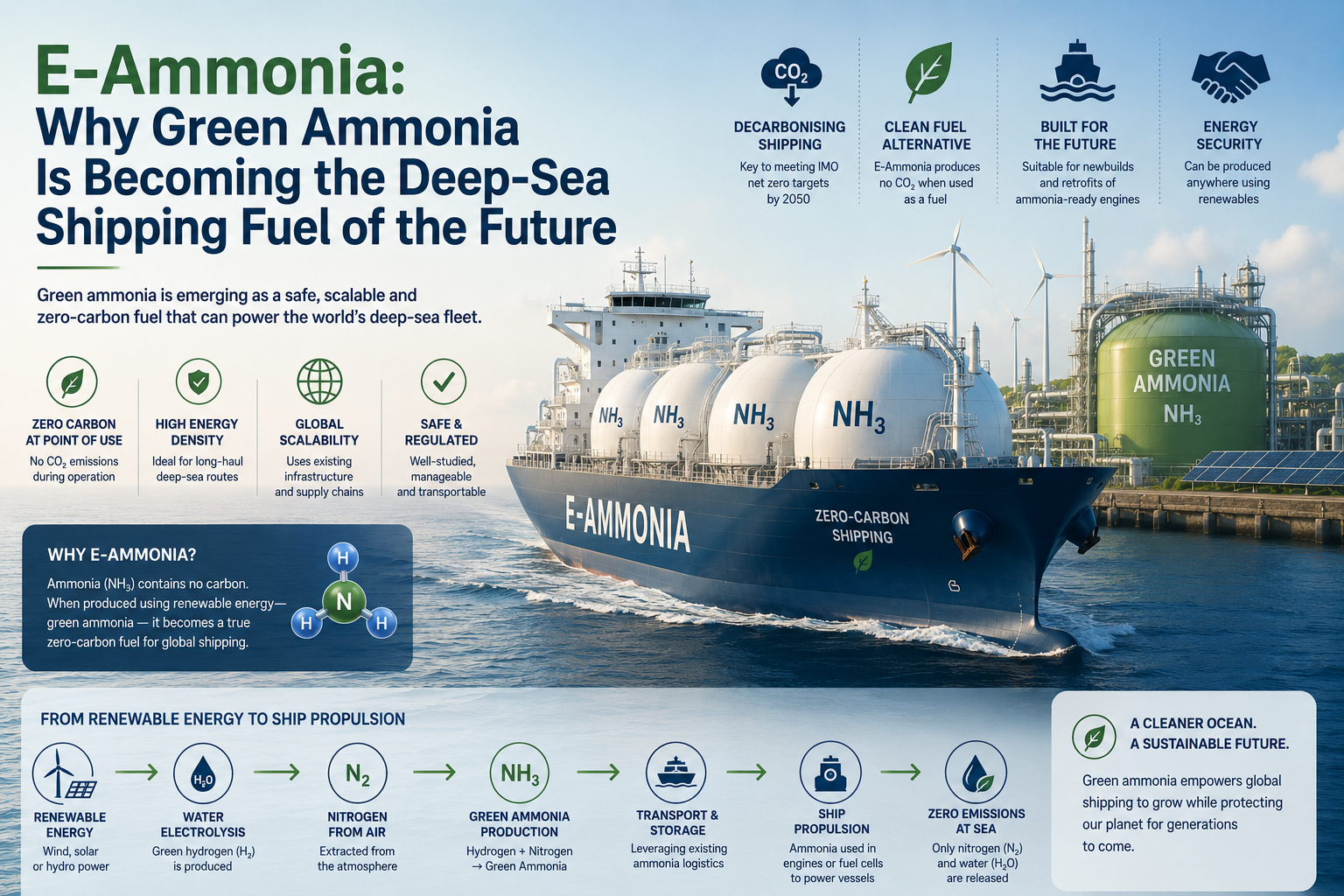
E-Ammonia: Why Green Ammonia Is Becoming the Deep-Sea Shipping Fuel of the Future

E-Ammonia: Why Green Ammonia Is Becoming
the Deep-Sea Shipping Fuel of the Future
In 2026, the world’s first ammonia-powered container ship — Yara Eyde — enters commercial service on the Oslo-Hamburg route. NEOM, the world’s first large-scale green hydrogen ammonia plant in Saudi Arabia, begins commercial production in 2027. Air Products and Yara are in advanced negotiations to distribute up to 1.2 million tonnes per year of renewable ammonia globally. And FuelEU Maritime grants a 2× compliance multiplier for e-ammonia until 2033. E-ammonia is no longer a research project. It is becoming a shipping industry.
Why Ammonia for Deep-Sea Shipping? — The Engineering Case
International shipping needs fuels that can be stored onboard for weeks or months at a time, at quantities measured in thousands of tonnes per voyage. This immediately eliminates most solutions that work well for land transport. Battery packs heavy enough to power an ocean-going cargo vessel across the Pacific do not exist and are not physically feasible with any foreseeable battery technology. Compressed hydrogen requires enormous onboard pressure vessels. Liquid hydrogen at -253°C demands cryogenic storage that adds prohibitive complexity and cost to vessel design.
Ammonia (NH₃) solves most of these problems. It is liquid at -33°C at atmospheric pressure — manageable with technology the industry already uses for LPG carriers. It has a volumetric energy density higher than liquid hydrogen, meaning less storage volume is required per unit of energy. It contains no carbon, so its combustion produces no CO₂. And Yara alone already transports 4 million tonnes of ammonia per year across its existing fleet of 15 ammonia carriers — the infrastructure and handling expertise exist at commercial scale today.
The remaining engineering challenges are real but tractable: ammonia’s toxicity requires specialised crew training and safety protocols; its low flame speed requires modified combustion systems; and bunkering infrastructure at ports is still limited. None of these are fundamental barriers — they are implementation challenges that the industry is actively resolving.
- vs Liquid hydrogen — ammonia has higher volumetric energy density · liquid at -33°C vs -253°C for H₂ · existing global infrastructure for storage and transport
- vs E-methanol — ammonia is carbon-free (no CO₂ at combustion) · methanol contains carbon → must capture CO₂ to be carbon-neutral · ammonia simpler for decarbonisation accounting
- vs Bio-LNG — ammonia produces zero CO₂ at combustion · LNG still emits CO₂ even when bio-sourced · ammonia qualifies for 2× FuelEU multiplier
- vs Battery — not feasible for deep-sea long-distance · energy density too low · charging time incompatible with commercial shipping schedules
Yara Eyde — The World’s First Commercial Ammonia Container Ship
The Yara Eyde is not a demonstration vessel. It is a commercial operation: a 1,400 TEU container ship ordered from Qingdao Yangfan Shipbuilding, developed through a partnership between Yara Clean Ammonia, CMB.TECH’s container division Delphis, and North Sea Container Line. The ship carries Yara’s own fertiliser products (40–60% of capacity) alongside third-party cargo for businesses seeking to reduce their scope 3 emissions. It operates between the Oslofjord area and European continental ports — Hamburg, Bremerhaven — on a fixed commercial route.
From 2026, Norwegian companies can trade their products emissions-free in and out of Norway. This is not a pilot. It is a supply chain decarbonisation service available to cargo owners today.
No one is better positioned than Yara to capture value in the clean ammonia market. We’re the world’s second-largest ammonia producer and operate the largest export and trading network. When the ships are ready, the fuel will be too.
Hans Olav Raen · CEO · Yara Clean AmmoniaNEOM and the Supply Chain — Industrial Scale from 2027
The Yara Eyde solves the demand side. The supply side is being solved by NEOM. The NEOM Green Hydrogen Project in Saudi Arabia — in which Air Products holds a majority stake — is over 90% complete as of late 2025 and is expected to begin commercial production in 2027. It will produce up to 600 tonnes per day of carbon-free hydrogen in the form of green ammonia, using renewable energy exclusively. At 1.2 million tonnes per year of renewable ammonia, NEOM will be the world’s first large-scale green hydrogen ammonia production facility.
In December 2025, Air Products and Yara announced advanced negotiations to enter a marketing and distribution agreement under which Yara would commercialise and distribute NEOM ammonia worldwide using its existing shipping fleet. The marketing and distribution agreement is targeted to be completed during the first half of 2026. If concluded, this would give Yara Clean Ammonia access to a massive volume of certified renewable ammonia that it could sell to shipping companies seeking FuelEU Maritime compliance — creating the first genuinely global green ammonia supply chain at commercial scale.
The FuelEU 2× Multiplier — Why the Window Until 2033 Matters
FuelEU Maritime grants renewable fuels of non-biological origin used in fuel cells — which includes green and e-ammonia in fuel cell configurations — a 2× compliance multiplier until 2033. In practical terms, this means that a ship operator who uses e-ammonia counts each unit of fuel consumed as two units for the purpose of GHG intensity reduction calculations. A carrier that locks in ammonia supply agreements and vessel orders before 2033 therefore achieves its FuelEU compliance targets at half the fuel cost of a carrier using equivalent-energy conventional alternatives.
After 2033, the multiplier disappears and e-ammonia competes on equal terms. The window of first-mover advantage is defined and closing. This explains the urgency behind Yara’s commercial partnerships and vessel ordering schedules — the economic case for early commitment is strongest now, before the incentive narrows.
| Project | Location | Capacity | Status | Key partner |
|---|---|---|---|---|
| NEOM Green H₂ | Saudi Arabia | 1.2 Mt/yr renewable NH₃ | Production 2027 | Air Products · Yara distribution |
| Yara Herøya | Norway | 24 MW · renewable H₂ + NH₃ | Operational 2025 | Yara Clean Ammonia |
| Louisiana Clean Energy | USA | TBD · FID mid-2026 | FID targeted mid-2026 | Air Products · Yara |
| Yara Eyde vessel | Oslo–Hamburg route | 1,400 TEU commercial | 2026 entry service | CMB.TECH · NSCL · Yara |
| Port Dampier bunkering | Australia | Ship-to-ship transfer | Trials completed | Yara · Pilbara Ports Authority · GCMD |
The Natural Hydrogen Connection — What Changes at €0.50/kg H₂
Green ammonia is produced via the Haber-Bosch process — combining hydrogen with atmospheric nitrogen. Hydrogen represents approximately 50–60% of the production cost of ammonia. At current green electrolytic hydrogen costs of €6–12/kg, green ammonia costs significantly more than fossil-derived grey ammonia. The 2× FuelEU multiplier and EU ETS carbon costs partially bridge this gap for European shipping, but the economics remain dependent on regulatory support.
If natural geological hydrogen from the Lorraine Basin — where FDE confirmed concentrations of 49.6% at 2,426 metres in June 2026, targeting first commercial production at €0.50/kg in late 2028 — reaches commercial scale, the economics of e-ammonia change structurally. At €0.50/kg H₂, green ammonia produced in the Greater Region (Belgium, Luxembourg, France) becomes cost-competitive with fossil grey ammonia without any subsidy. For the maritime industry, this represents a potential end to the green premium — the point at which decarbonisation becomes the economically rational choice, not just the regulatory one.
Related portals
